





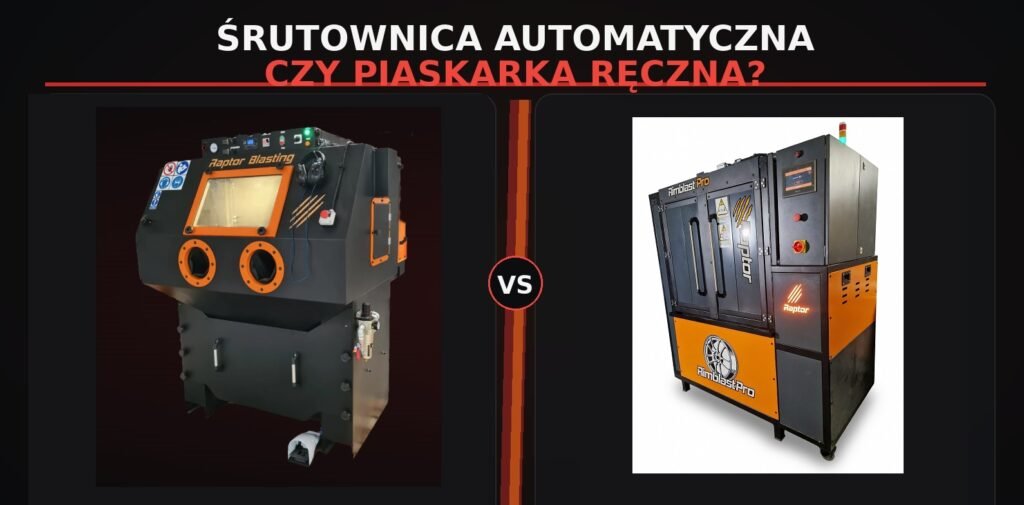
When reconditioning rims, the question often arises whether purchasing an automatic shot blasting machine means that a classic cabin sandblasting machine is no longer necessary.
In practice, both devices perform similar types of surface treatment, but their greatest advantages are completely different. Therefore, in a well-organized workshop, they don't have to compete with each other – they can complement each other very well.
What does an automatic shot blasting machine offer?
The biggest advantage of the machine is the ability to evenly process the entire available rim surface without the operator having to constantly guide the nozzle.
The wheel rotates in the chamber, and the abrasive jet acts on successive sections of the surface in a repeatable process. This solution allows for uniform component preparation and reduces manual work. Automatic shot blasting systems are designed specifically for consistent surface coverage, high throughput, and reduced manual intervention.
With a properly repainted wheel, most of the surface doesn't require intensive cleaning in any one specific spot. First, it needs to be evenly matted, cleaned of any minor residue, and prepared for the next stage of the restoration.
The machine is very well suited for this type of work.
Where does a hand-held sandblaster have an advantage?
The operator working in the sandblasting cabin constantly monitors the surface being processed.
If a small piece of old coating remains in a corner, on a rim shoulder or in a recess, the operator can aim the nozzle exactly at that spot and work on it for as long as needed.
There is no need to intensively process the entire surface again.
This is the biggest advantage of a hand-held sandblaster in case of local problems.
By design, the machine works more evenly. If the 95% surface is already properly prepared and the problem is only in a small area, further extending the cycle doesn't always make sense.
The machine does not have to replace the sandblaster
A very good way to organize work is to use a machine to prepare the entire surface and a manual sandblaster only for spot corrections.
Thanks to this, the employee does not have to spend several dozen minutes in the booth, manually polishing the entire set of rims.
After loading the rim, the machine carries out its work, while the operator can continue with the next steps of the process: preparing the previously machined rim, performing masking, surface inspection, preparing for primer or other workshop activities.
Every few minutes he comes back only to remove the finished rim and put in the next one.
Why does this matter to workshop efficiency?
The biggest benefit of automation is not always the shorter processing time itself.
Much more important may be that the working time of the machine ceases to be entirely human working time.
When sandblasting manually, the operator must guide the nozzle at all times.
With an automatic machine, the machine works independently for most of the cycle, and the operator can perform other activities.
In practice, one employee can therefore carry out several process stages in parallel instead of spending all his time only on preparing the surface of one rim.
When is a sandblaster still needed?
A hand sandblaster is very useful when:
- remnants of the old coating are only localized,
- there is more corrosion at one point,
- you need to clean the cavity or hard-to-reach part more thoroughly,
- a specific place requires a longer exposure to the abrasive than the rest of the rim.
The machine then performs most of the repetitive work, and the operator uses the sandblaster only where his control is actually needed.
Shot blaster or sandblaster?
In a larger establishment, the question should not always be:
„Shot blaster or sandblaster?”
More practical is:
„Which part of the work should be automated and which should be left to the operator?”
The automatic shot blasting machine ensures repeatability and allows you to regain operator time.
A manual sandblaster, on the other hand, allows for precise operation exactly where it is needed.
Only by combining both technologies can we take advantage of the strengths of each of them.